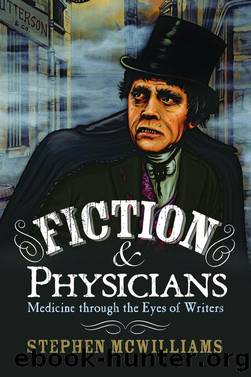
Fiction and Physicians by Stephen McWilliams
Author:Stephen McWilliams [Stephen McWilliams]
Language: eng
Format: epub
ISBN: 9781905785382
Publisher: The Liffey Press
Published: 2012-01-15T00:00:00+00:00
Mister Frankenstein
If Drs Slop and Bovary were written into their respective stories only to provide comic relief, there are several other fictional physicians whose characteristics are central to the themes of novels. Think of the clichéd mad scientist who finds himself in hot water when his ambitious experiments go wrong. Alas, to begin this line of enquiry, it is necessary to stray marginally beyond our brief. One aim of Fiction & Physicians is to elicit the occasional enthusiastic response: âWow, I never realised he (or she) was a doctor!â But with Victor Frankenstein, the reverse is the case; many donât seem to realise he is not.
At least this is the case if we choose to be rigid about how we classify a doctor. Over the past two centuries, Mary Shelleyâs Frankenstein, or The Modern Prometheus (1818) has been adapted time and time again for stage, film and television. The first stage adaptation was Richard Brinsley Peakeâs Presumption; or the Fate of Frankenstein (1823), while classic film adaptations include James Whaleâs Frankenstein (1931), his sequel The Bride of Frankenstein (1935), and Kenneth Branaghâs Mary Shelleyâs Frankenstein (1994). Picture the monster and we typically see Boris Karloff with outstretched arms, a flat head and a bolt through his neck. Indeed, the legend has been twisted and reinvented so many times that many people still erroneously consider Frankenstein to be the name of the monster and not its creator. More importantly, several adaptations incorrectly refer to Frankenstein as a medical doctor â or even a baron.
According to the original text, he is neither. Having developed an interest in academia during childhood, he sets off for the University of Ingolstadt to study natural philosophy with a particular interest in chemistry. Yet his motivation is not dissimilar to that of a medical student in that he has a yearning for knowledge on how to preserve life. For example, he remarks enthusiastically, âWealth was an inferior object, but what glory would attend the discovery if I could banish disease from the human frame and render man invulnerable to any but a violent death!â
Frankensteinâs choice of subjects is also medical. He asserts that, âOne of the phenomena which had peculiarly attracted my attention was the structure of the human frame, and, indeed, deed, any animal endued with life.â He goes on to reveal that he âdetermined thenceforth to apply myself more particularly to those branches of natural philosophy which relate to physiologyâ. He furthermore becomes âacquainted with the science of anatomyâ sufficiently to âprepare a frame for the reception of (animation), with all its intricacies of fibres, muscles, and veins ⦠a work of inconceivable difficulty and labourâ. Finally, he learns to âobserve the natural decay and corruption of the human bodyâ, a science otherwise known to us as pathology.
Frankensteinâs work ethic might have suited a career in medicine, although his own health ultimately suffers as a result of his endeavours. He describes himself as âone doomed by slavery to toil in the mines, or any other unwholesome trade than an artist occupied by his favourite employmentâ.
Download
This site does not store any files on its server. We only index and link to content provided by other sites. Please contact the content providers to delete copyright contents if any and email us, we'll remove relevant links or contents immediately.
4 3 2 1: A Novel by Paul Auster(12405)
The handmaid's tale by Margaret Atwood(7773)
Giovanni's Room by James Baldwin(7353)
Big Magic: Creative Living Beyond Fear by Elizabeth Gilbert(5780)
Asking the Right Questions: A Guide to Critical Thinking by M. Neil Browne & Stuart M. Keeley(5779)
Ego Is the Enemy by Ryan Holiday(5455)
The Body: A Guide for Occupants by Bill Bryson(5103)
On Writing A Memoir of the Craft by Stephen King(4948)
Ken Follett - World without end by Ken Follett(4740)
Adulting by Kelly Williams Brown(4582)
Bluets by Maggie Nelson(4563)
Eat That Frog! by Brian Tracy(4546)
Guilty Pleasures by Laurell K Hamilton(4454)
The Poetry of Pablo Neruda by Pablo Neruda(4113)
Alive: The Story of the Andes Survivors by Piers Paul Read(4037)
White Noise - A Novel by Don DeLillo(4018)
Fingerprints of the Gods by Graham Hancock(4009)
The Book of Joy by Dalai Lama(3996)
The Bookshop by Penelope Fitzgerald(3857)
